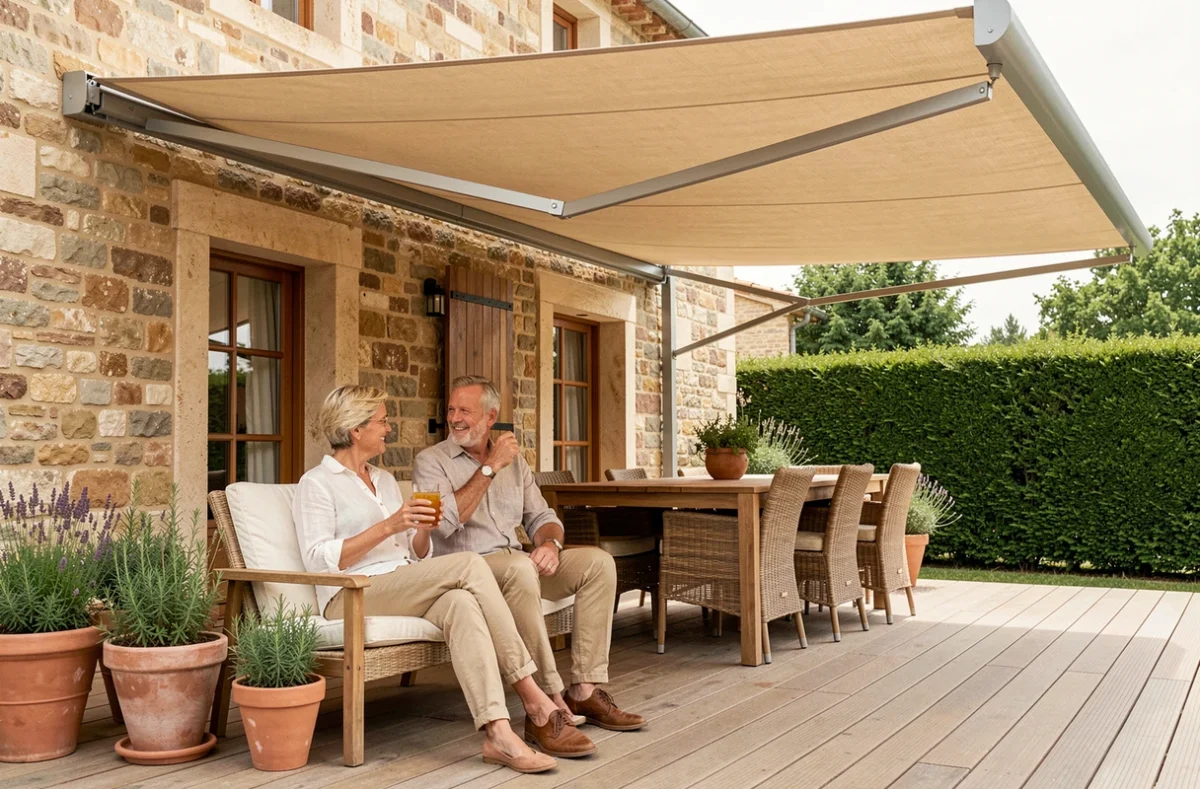
A south-facing terrace with a large bay window is pleasant in April, but in July, the indoor temperature rises quickly and the garden furniture becomes unusable between noon and four o’clock. The awning solves this problem by creating an adjustable shaded area without encroaching on the ground space. However, it is essential to choose the right model, as a poorly sized or poorly fixed awning will not protect either the terrace or the facade.
Wind resistance and fixing: what to consider before purchasing the awning
It is common to see awnings torn off after a storm or deformed after a few seasons. The problem rarely comes from the fabric. It arises from the fixing and exposure to wind, two parameters that are often underestimated at the time of ordering.
The EN 13561 standard classifies awnings according to their wind resistance, but this classification guarantees nothing if the fixings are inappropriate. An awning installed on a hollow wall with standard anchors will not hold up like an awning anchored in solid concrete with suitable screws. Before choosing a model, it is necessary to know the nature of the facade support.
The orientation of the terrace also matters. A lateral wind that rushes under the fabric exerts much greater pressure than a frontal wind. If the terrace is exposed to dominant side winds, an awning with a full cassette and reinforced arms will be more suitable than a lightweight monobloc.
A wind sensor can automatically retract the awning when gusts increase, which limits damage. However, this device does not replace the instinct to retract the awning as soon as the weather deteriorates. One should not leave an awning deployed during a storm, sensor or not.
To choose the right awning, one should start by assessing the strength of the wall, wind exposure, and the type of fixing required, not by the color of the fabric.
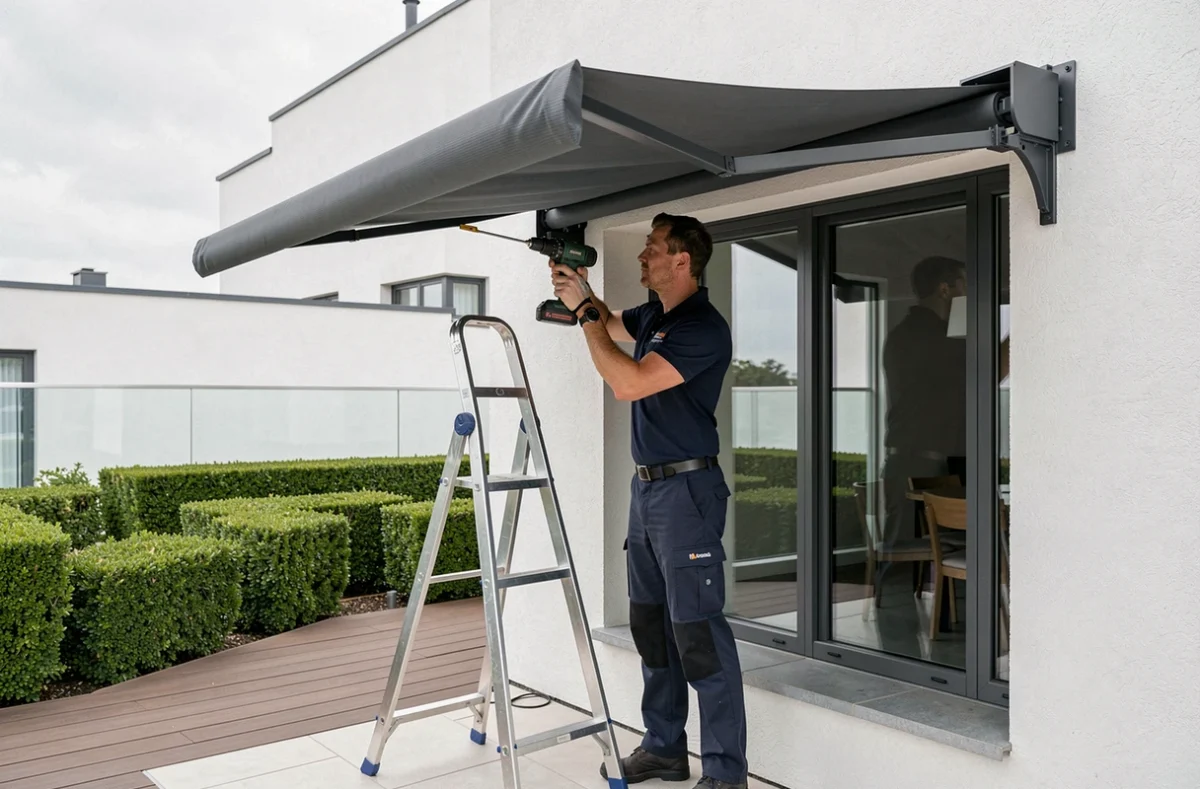
Full cassette, semi-cassette, or monobloc: which type of awning for which terrace
The choice between these three configurations is not just a matter of budget. It depends on where the awning will be installed and what is expected of its lifespan.
- The monobloc awning leaves the fabric and mechanism exposed once retracted. It is suitable for a terrace sheltered under a canopy or a covered balcony, where the weather does not directly reach the frame.
- The semi-cassette (or cassette awning) protects the fabric from above but leaves the arms exposed. It is an acceptable compromise for a facade moderately exposed to rain.
- The full cassette encloses the fabric, arms, and mechanism in a closed casing. On an unprotected facade, it is the only option that truly preserves the components over time. The fabric does not mold, and the arms do not oxidize.
In a co-ownership situation, the question of the type of awning may arise differently. The exterior appearance of the facade is often regulated by the co-ownership rules, and installation may require approval from the property manager. Some municipalities also impose heritage requirements or formalities at the town hall. These points should be checked before ordering, not after.
Acrylic or polyester fabric: the choice that determines the lifespan of the awning
The fabric is what we see, what we touch, and what degrades first if we make the wrong choice. Two materials dominate the market: polyester and acrylic. They age differently.
Polyester is cheaper to purchase. It is suitable for occasional use or a terrace that is not highly exposed. However, its UV resistance decreases faster than that of acrylic, and colors fade within a few seasons in a south-facing exposure.
Mass-dyed acrylic retains its properties much longer. The dye penetrates the entire thickness of the thread, meaning the color does not fade on the surface. Acrylic fabrics also offer better resistance to water and mold.
The weight of the fabric also plays a role. The higher it is, the more the fabric filters heat and resists micro-tears. A sufficiently dense weight is preferred for a terrace exposed for several hours a day.
Awnings dimensions: width and projection suitable for the terrace
An awning that is too narrow allows sunlight to come through on the sides as soon as the angle changes. An awning that is too short in projection only protects a narrow strip in front of the facade. Both mistakes are common.
The width of the awning must exceed that of the area to be shaded by at least a few dozen centimeters on each side. If the terrace is three meters wide, a three-meter awning will not be sufficient: the low morning or evening sun will spill over significantly.
The projection (the depth of extension) determines how far the shade reaches. It depends on the height of fixing and the angle of inclination. The higher the awning is fixed, the greater the projection must be for the shade to reach the living area. Generally, a projection that covers at least the table and seating is aimed for, not just the threshold of the bay window.
For a deep terrace, a significant projection requires longer articulated arms and a more stressed mechanism. In this case, motorization becomes a real daily comfort: manually unfolding a large awning with a crank requires real effort, and one ends up not using it.
Manual or electric motorization: when the awning becomes truly practical
The crank works, but it limits usage. On a small awning, it remains acceptable. Beyond a certain width and projection, motorization is no longer a luxury; it is what makes one actually use the awning daily.
A tubular motor integrated into the roller allows the awning to be deployed and retracted in seconds, via a wall switch or remote control. Some models accept sun and wind sensors that automate operation: the awning deploys when the sun shines and retracts when the wind picks up.
Planning for electrical supply before installation avoids running an exposed cable on the facade. If the terrace is under construction or renovation, now is the time to run a conduit. For an existing installation, an electrician can usually connect the motor from a nearby electrical point.
The awning remains a durable investment when one takes the time to consider these criteria: fixing support, wind exposure, type of cassette, fabric quality, and precise sizing. A model suited to the actual configuration of the terrace provides effective protection for many seasons, without unpleasant surprises.