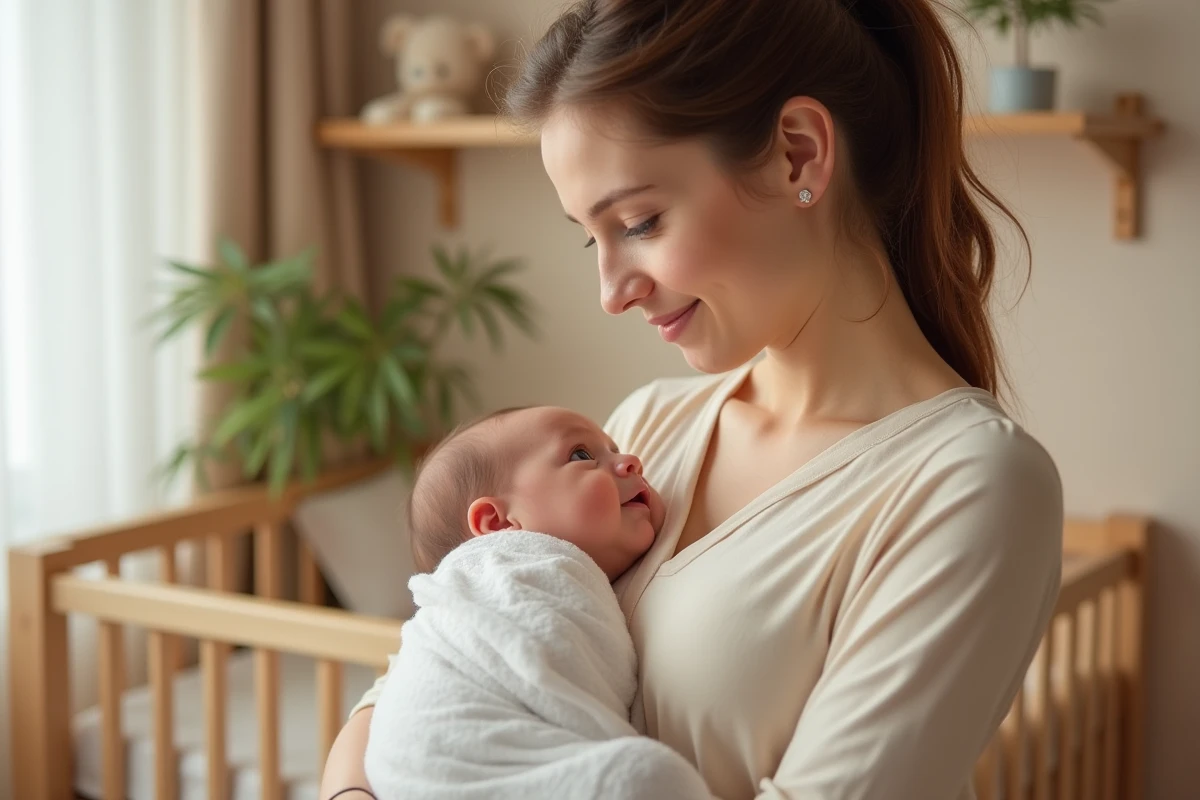
A newborn placed on its mother’s belly turns its head towards her breast without being guided. This gesture, observed in the first minutes of life, is not a coincidence. The baby’s recognition of its mother begins well before birth and develops step by step, sense by sense, over the first weeks and then the first months.
Baby’s recognition before birth: what happens in utero
Most parents imagine that everything starts at the maternity ward. However, the fetus is already recording sensory information during pregnancy. Among these, the mother’s voice holds a special place.
The study by DeCasper and Fifer, published in the journal Science in 1980, showed that newborns change their sucking patterns depending on whether they hear their mother’s voice or that of an unknown woman. This difference in sucking proves a vocal memory acquired before birth. The fetus has spent months bathed in amniotic fluid, where low sounds and vibrations of the mother’s voice reach it in a privileged way.
More recent work, such as that of Kisilevsky and colleagues published in Infant Behavior & Development, confirms that the fetus at the end of pregnancy modulates its heart rate in response to its mother’s voice. This is not just a reflex: it is a specific familiarity, built day by day. You will find information on Your Health Assistant that details these early sensory stages.
Smell, voice, visual contrasts: the three channels of early recognition
At birth, the baby does not see clearly. Its vision is limited to about twenty centimeters, which corresponds to the distance between the breast and the mother’s face during breastfeeding or bottle-feeding. But it already has two very sharp senses: smell and hearing.
Smell, the first sensory marker
The newborn recognizes the smell of amniotic fluid and breast milk within the first hours. This smell is familiar to it because it extends its intrauterine universe. A baby placed between two compresses, one soaked in its mother’s milk and the other in that of another woman, turns its head towards its mother.
Hearing, already trained
The mother’s voice is the sound the baby has heard the most during pregnancy. It brings about a measurable calming effect (slowing of heart rate, decrease in agitation). This is not the case with an unknown female voice, even if the tone is similar.
Vision, slower to develop
The newborn prefers very contrasting faces, with well-defined dark and light areas. The mother’s face, often the closest and best lit during care, is therefore easier to process visually. The preference for the maternal face appears within the first days, but it relies more on contour markers (hairline, shape of the face) than on fine details.
If the mother radically changes her hairstyle or wears a hat that obscures her hairline, the very young baby may no longer recognize her visually. Visual recognition remains fragile for several weeks.
Attachment and stable visual recognition: the stages after birth
Multisensory recognition (smell, voice, visual contours) develops very quickly. Emotional attachment, on the other hand, is built over time. These are two related but distinct processes.
- During the first weeks, the baby recognizes its mother mainly by smell and voice. It calms in her arms, seeks her breast, reacts to her presence.
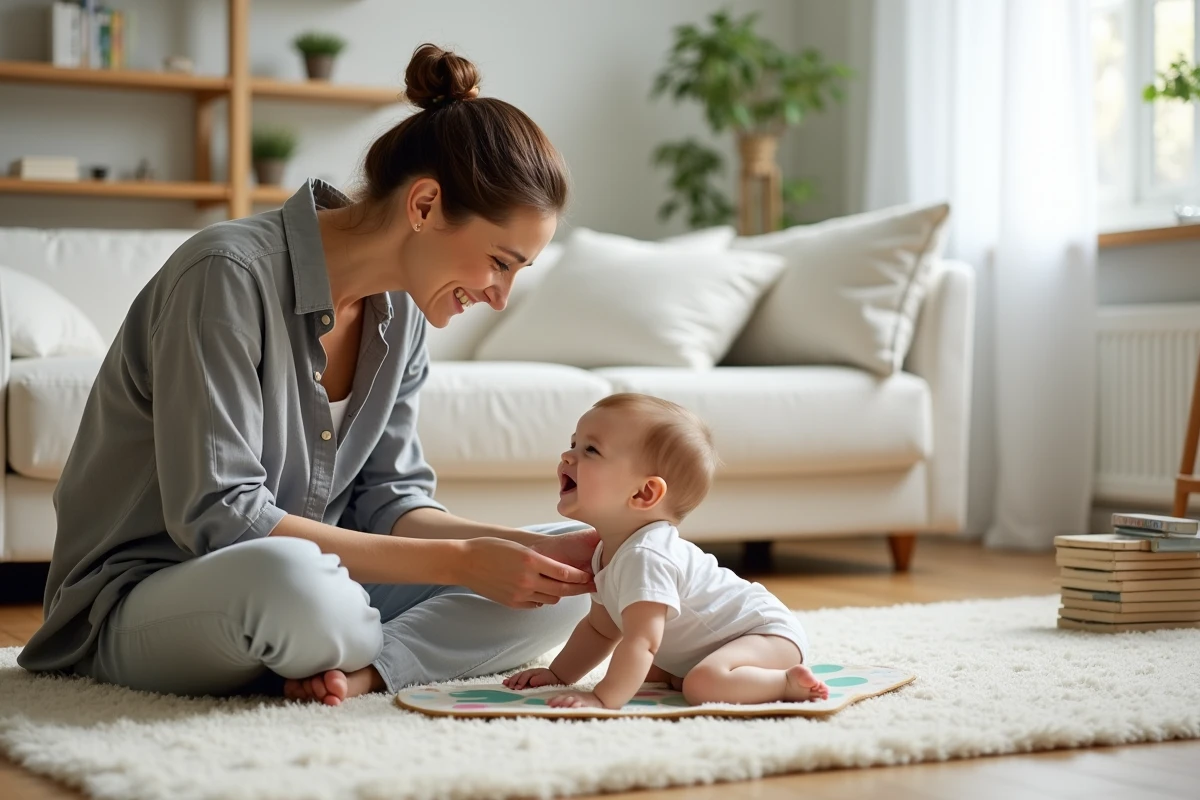
- Around two to three months, vision sharpens. The baby begins to smile specifically at familiar faces. It distinguishes the features of the maternal face better, not just the contours.
- Around four to five months, the baby shows a clear and stable preference for its mother, including visually. It follows her face with its gaze, smiles more upon seeing her, and may show discomfort in response to an unfamiliar face.
- Between six and nine months, separation anxiety often appears (sometimes called eight-month anxiety). The baby cries when its mother leaves or when a stranger approaches. This is a sign that the attachment figure is clearly identified.
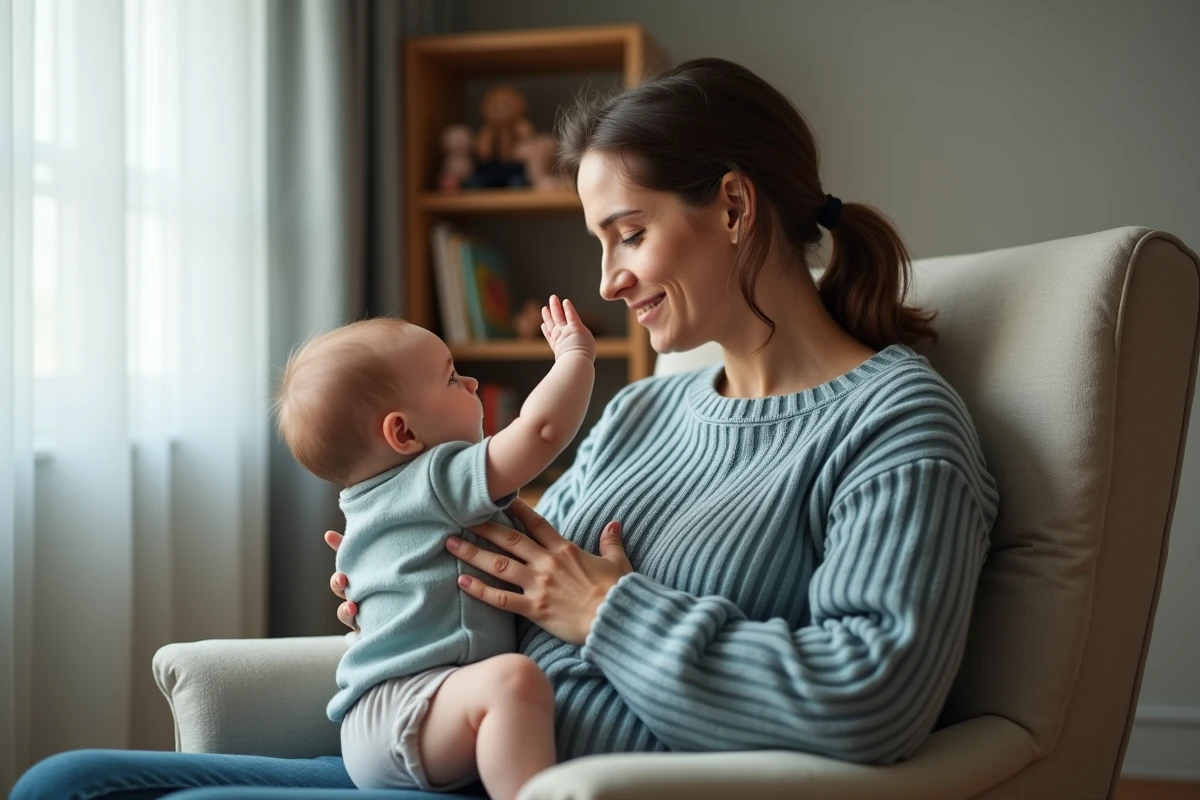
Separation anxiety worries many parents, but it is a marker of normal development. It means that the baby has built a sufficiently stable representation of its mother to notice her absence.
Attachment figure: the biological mother is not always the only one
Research on attachment, initiated by John Bowlby and later extended by Mary Ainsworth, shows that the baby attaches to the person who regularly responds to its needs. In most cases, it is the biological mother, but not always.
A baby adopted in the first weeks will build its main attachment bond with its adoptive mother, provided that she consistently provides daily care. Skin-to-skin contact, carrying, and responding to cries: these repeated interactions forge the bond of emotional security.
Have you noticed that your baby smiles just as easily at its father or the caregiver? That’s normal. A baby can have multiple hierarchical attachment figures. The primary figure is the one it turns to in times of distress or fatigue. Other figures (father, grandparents, nanny) play a complementary role in its emotional development.
The fact that a baby does not cry when leaving its mother to go to the caregiver does not mean that it does not recognize her or that it is not attached to her. It may simply reflect a secure attachment: the child trusts in the return of its mother.
The baby’s recognition of its mother is not a one-time event, but a progressive construction. It begins with sensory reflexes in utero, is strengthened by physical contact and daily care, and then stabilizes around the fourth or fifth month with vision. Separation anxiety, a few months later, simply confirms that the bond is well established.